US influence on international research partnerships in decline | News
- Chemical
Fallon Wolken
- 0
- 8 minutes read

A new analysis of co-authorship of scientific papers suggests that the US may be losing its dominant position in the global research ecosystem. The report notes that the US ‘appears in decline as a research partner’, while scientists elsewhere are forging partnerships more rapidly with colleagues from other countries.
The findings come from researchers at Clarivate’s Institute of Scientific Information who analysed decades of authorship data covering papers indexed by Web of Science (WoS) to identify trends in global research collaboration.
Overall, the researchers note that the number of scientific papers being published each year is growing – a trend that has continued for decades. And over time, an increasing proportion of these papers are being authored by colleagues from more than one country. These collaborations also seem to be becoming more international, with the Clarivate team identifying a shift away from bilateral partnerships towards projects that involve contributors from several countries.
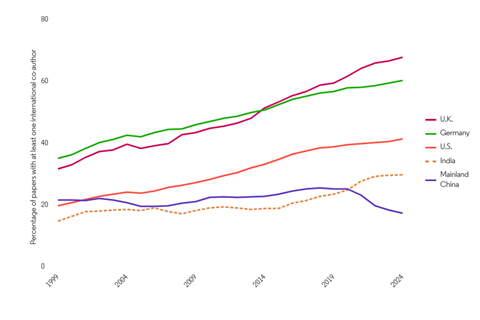
Mainland China is the only region where the growth of domestic research activity has outpaced the growth of research carried out in international partnerships – although the total number of papers published by Chinese authors as part of wider international collaborations is still rising. In the year 2000, researchers in mainland China published 26,200 papers in journals indexed in the WoS core collection. In 2024 that number had risen to 878,300. Of these, 163,230 were produced in partnership with foreign colleagues, in comparison to just 6000 at the turn of the century.
Global power shift
The Clarivate team also identified trends in collaborations between researchers in the US, Europe and China – the three blocs that contribute the most research papers each year.
While there were spikes in international collaboration around the first years of the Covid-19 pandemic, overarching trends appear to show that partnerships between European and Chinese authors are increasing at a faster rate than partnerships between European and US researchers. Meanwhile, collaborations between US and Chinese researchers have declined sharply since 2019.
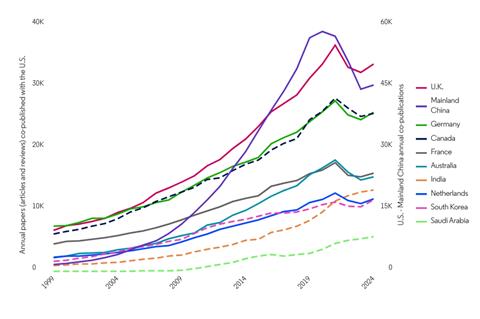
In terms of total numbers of papers, Chinese authors published more articles than their US counterparts for the first time in 2020, and the gap has increased dramatically in the years since.
When the data is normalised to account for research impact (by factoring in the number of times a paper is cited), it reflects the increasing standard of research conducted in China. Collaborations involving US and European researchers are shown to benefit from partnerships with Chinese researchers. And while papers authored by Chinese authors alone appear to be increasingly impactful, the overall impact of papers authored solely by US authors appears to be in decline.
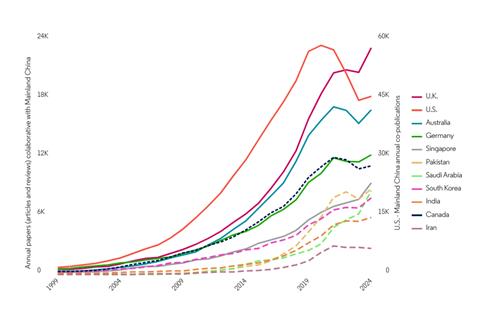
The report also notes that researchers in Africa, Asia-Pacific, Latin America and the Middle East are entering research collaborations with colleagues in mainland China at an increasing rate. And while the US is still the most popular partner in all regions except Asia, the proportion of papers published by researchers in all regions are the result of collaborations with US researchers seems to be in decline. For example, while almost 12% of papers published by researchers from the Asia-Pacific region in 2015–2019 were the result of collaborations with US partners, in 2020–2024 that had fallen to around 9%. Over the same period, the proportion of papers published with Chinese colleagues rose from 4.5% to 5.3%.
‘The US research base no longer appears as competitive in global performance as it was in the past,’ the report’s authors note. ‘The data show that the US receives a significant academic benefit from collaborative partnerships, which have generated its highest-performing research output. So, if these partnerships decline, then that will be to the further detriment of US research.’
‘The US appears in decline as a research partner: its growth has weakened; its citation impact is falling; it may be losing its dominant lead in global research,’ they add. ‘Recent policy statements regarding its overseas links point to negative implications for its own research future and for global networks.’
A new world of research
According to Marek Kwiek, an expert on international academic collaboration from the Adam Mickiewicz University in Poland, the report illustrates ‘a new world of global research in the making’. ‘Perhaps the most interesting shift is the growing role of mainland China in global research collaboration, and the declining role in the US,’ he says. ‘To some extent, the changes in research collaboration represent global geopolitical tensions and national policies in the US. Interestingly, the US is gradually losing its globally dominant research position, with the fast increase of mainland China in both quantity and, above all, quality of research output.’
Kwiek notes that the report ‘confirms trends in global research collaboration of which we are well aware’, adding that ‘policy matters’ both in China and the US. ‘Mainland China is described in the report as being on track “to be a major technological economy, underpinned by existing research and supported by growing investment in life sciences and health”,’ he adds. ‘The report depicts global research collaboration in which both China and the EU are on the rise and the US is declining, after decades of dominance by US science as a “soft diplomacy” tool.’